

Are you overanalyzing your relationship? Although it’s typical, you can break the pattern. This manual provides useful techniques for controlling nervous thoughts, enhancing communication, and creating a more solid, secure bond. A healthier, happier relationship can result from learning how to stop overthinking in a relationship, recognize triggers, cultivate trust, and engage in mindfulness exercises.
Relationships are wonderful, full of connection, joy, and laughter. But occasionally, overthinking a well-known thief clouds that happiness. It’s a cunning little gremlin that whispers concerns and doubts, exaggerating the situation and making you feel uneasy. Many of us have experienced this emotion at some point. You’re not alone, so don’t worry. This manual will provide you a methodical approach to controlling those bothersome thoughts and creating a more robust, healthy connection. Together, let’s take on this!
Why Do I Think About Relationships Too Much?
Relationship overthinking is typically caused by problematic thought patterns, past experiences, and deeper worries. Even in a healthy relationship, the following are the most typical causes:
Clear communication is lacking
You might fill in the blanks with assumptions if you don’t communicate your requirements clearly or are unsure of your partner’s feelings, making the worst-case scenario seem like the only practical choice.
You’re attempting to feel certain
Uncertainty is a fundamental part of relationships. You have no complete control over another person’s feelings, actions, or future. Some people find that uncertainty unsettling, so their minds attempt to minimize it. It accomplishes this by continuously assessing the circumstances. You might find yourself looking for confidence, attempting to make sense of things, or searching for indications that everything is alright. These ideas can actually make you feel even more nervous, unsure, and emotionally spent, even though they are frequently an attempt to feel more secure in the relationship.
You have an apprehensive attachment style
Anxious attachment types frequently fear losing intimacy, perceive neutral reactions and behaviors as negative, and look to ongoing reassurance for emotional security. Understanding how to stop overthinking in a relationship can help manage these fears and build greater emotional security.
You have pessimistic mind patterns
Catastrophizing, mind-reading, and assuming the worst are examples of patterns that can make neutral activity appear dangerous and encourage overanalyzing or rash decisions. Anxiety can also contribute to overthinking. If you tend to feel anxious or overwhelmed in general, you may find yourself experiencing the same feelings in your relationship, leading to excessive worry and doubt.
Self-doubt is a factor
Relationship overthinking is frequently associated with low self-esteem. If you experience overthinking more frequently in your life, you may find this useful: How to Quit Thinking Too Much. Thoughts like “Have I said the wrong thing?” may come to mind. Are they genuinely fond of me? Am I sufficient?
Your mind may become preoccupied with attempting to shield you from failure or rejection when there is some degree of underlying self-doubt. Once more, protection is the goal. However, it can lead to a vicious cycle that is hard to break.
Indications That Your Relationship May Be Overthought

Everyone occasionally worries about their connection. Overthinking, however, can become a problem if it occurs regularly and interferes with your mental well-being.
You can be overanalyzing if you
- They frequently require reassurance and worry about little behavioral changes.
- Analyze your partner’s words and actions all the time.
- Verify texts several times.
- Without proof, assume something is wrong.
- Replay discussions in your mind.
- Examine your relationship against those of other couples.
- Keep an eye out for indications that your partner is becoming disinterested.
- Consider the worst-case situations.
- Because you’re constantly concerned about what can go wrong, you find it hard to appreciate the relationship.
14 Strategies to Quit Overanalyzing Your Relationship
It can be detrimental to both the relationship’s and your own mental health to overthink things. Particularly when feelings are running high, it’s simple to fall into a vicious cycle of anxiety, uncertainty, and rumination. Overanalyzing can lead to needless stress and tension, whether you’re doubting your partner’s motives, mentally repeating discussions, or continuously worrying about the worst.
Here are 14 practical strategies for putting an end to relationship overthinking:
1. Consider the Reasons Behind Your Overthinking
Although this may seem obvious, overthinking can actually happen without your awareness. Spend some time away from distractions investigating the root of your overthinking. Often, it’s simply simpler to assume the worst without considering the reasons behind your actions. You can begin to identify strategies to prevent yourself from overanalyzing once you understand why you’re doing it.
2. Examine Any Problems with Control
You may overthink things because you want to control your partner’s actions or the circumstances. Being overly controlling could be a sign of an unhealthy dynamic in your relationship. Think about what you can and cannot control. You have power over your responses and choices, but you have no control over what your partner says to you or how they act.
Related Reading: How Hormones Effect Women’s Mental and Emotional Health
3. Meditation and mindfulness
By focusing on the here and now, mindfulness techniques lessen the influence of worrying thoughts and can support you in learning how to stop overthinking in a relationship. Headspace and Calm are two apps that provide guided meditation.
4. Contest Negative Thoughts
Actively confront your negative thoughts when you discover yourself overanalyzing. Are they predicated on assumptions or on facts? Transform them into comments that are more upbeat and realistic.
5. Take a step back from the analysis
Ask yourself, “Is this helping me right now?” when your thoughts start circling. If not, it’s acceptable to give up trying to solve the problem. If necessary, you can revisit it at a later time when your thoughts are more at ease.
6. Develop open lines of communication with your spouse

Express your feelings and concerns to your partner rather than believing they “should know” what you need: “I’m a little insecure right now.” Can we discuss it? Instead of overanalyzing your relationship, engage in active listening and offer clarifying questions. You might say, “Hey, you seem a bit quiet today,” for instance. Is everything alright?
7. In a relationship, apply the 70/30 rule
30% of your time should be spent apart from your partner, and 70% should be spent together. Spending time alone can help you focus on your emotions, reduce stress, and have new experiences that you can share with your partner.
Additionally, a recent study on social connection discovered that persons who can meet various emotional needs through interactions with diverse people have a higher quality of life. For instance, a person might have parents who are dependable for support and empathy and a close friend who is always willing to have fun.
8. Stop Overthinking: Establish Limits
To safeguard your emotional health, set up appropriate limits and consider how to stop overthinking in a relationship. This may include cutting back on social media, scheduling personal time, or avoiding stressful discussions.
9. Give Up Searching for Hidden Meanings
Not every tone shift, facial expression, or message has a deeper meaning. A brief text could just indicate that your significant other is preoccupied. Even if you have a quiet evening, it doesn’t necessarily indicate they don’t like you. Before drawing the worst possible conclusion, try to think of straightforward explanations.
10. Avoid Seeking Assurance All the Time
For a brief while, reassurance might be consoling, but asking your partner whether everything is well all the time could prolong the worry cycle. Give yourself some time to analyze the emotion rather than asking for reassurance right away.
11. Don’t Check Your Phone All the Time
Overthinking can get worse while waiting for a message. Instead of checking to see if your spouse is online or has read your message, try putting your phone away for a bit. To determine whether someone cares about you, you don’t have to keep an eye on every data signal.
12. Develop Your Breathing Techniques
The nervous system and breathing are closely related; you breathe more quickly when you’re nervous, and you feel more nervous when you breathe quickly and shallowly. You will therefore observe a change when you frequently and consistently work with your breath.
13. Discover the Reality of Your Overthinking
Take some time to consider whether your overthinking is justified. Is it a story you’re inventing, or is there a good explanation? Has something stressful happened recently? Has your partner’s behavior changed? Examine your thoughts to see if you’re internalizing the idea that you don’t deserve love or a relationship, or if you’re picturing the worst-case scenario.
14. Seek Expert Assistance
If your everyday life or relationships are greatly impacted by overthinking, you might want to think about getting professional assistance from a therapist or counselor. They can offer tailored advice and tactics to help you understand how to stop overthinking in a relationship.
Related Reading: Mental Health Issues in Women: Symptoms and Their Treatment
Final Thoughts
When you overthink a relationship, you may start to doubt things that aren’t truly incorrect. Never having a nervous thought is not the aim. It’s to quit letting every idea become a reality.
It’s simpler to feel more confident when you learn to distinguish between facts and assumptions, speak honestly, cut back on reassurance-seeking, and give yourself space outside of the relationship. You deserve a relationship in which you are able to care passionately without having to worry about losing it all the time. For individualized support, think about contacting a licensed mental health professional if relationship overthinking is interfering with your day-to-day activities, sleep, or emotional wellness.
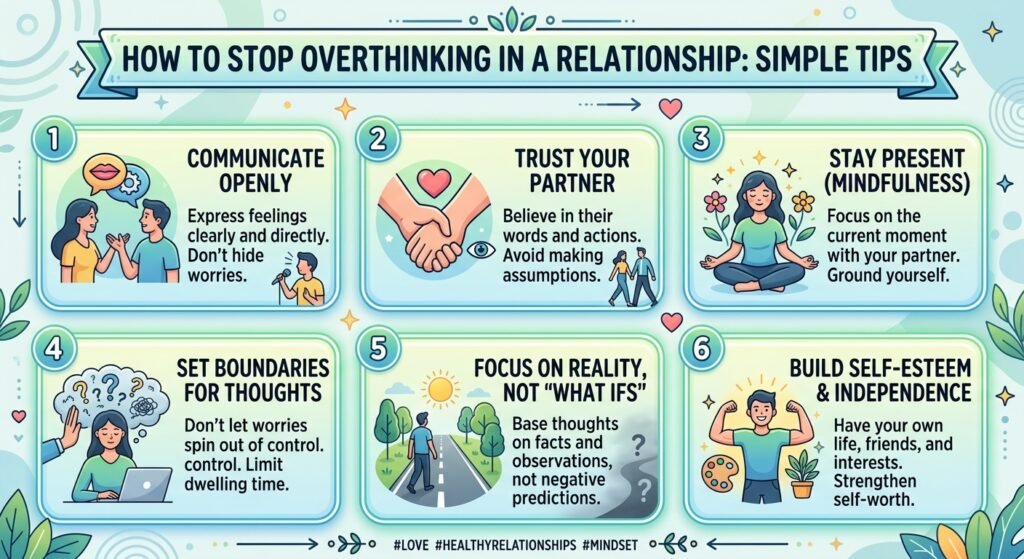
Frequently Asked Questions
1. How can I quit worrying too much about a relationship?
Try to distinguish facts from presumptions, confront pessimistic ideas, refrain from always looking for confirmation, and have honest conversations with your partner to quit overanalyzing in a relationship. Relationship anxiety can also be lessened by devoting time to your own hobbies.
2. Why do I obsess over every aspect of my relationship?
Fear of losing your spouse, past relationship experiences, insecurity, anxiety, or poor communication can all cause you to overthink your relationship. You can better understand why these ideas recur by identifying your triggers.
3. How can I stop thinking about my partner so much?
Instead than speculating about what might be going on, concentrate on what you actually know. Consider whether you have evidence to support any worst-case scenario your mind conjures up. After that, shift your focus to something else.
4. How can I quit worrying so much when my lover doesn’t respond?
A delayed response may not always indicate a problem. Your spouse can be sleeping, working, occupied, or not using their phone. Give yourself something else to concentrate on while you wait, rather than constantly checking your messages.
5. How can I tell if something is truly wrong or if I’m overanalyzing?
Instead than depending solely on fear, consider the facts. A single odd message or mood shift might not indicate a problem. On the other hand, persistent dishonesty, disrespect, manipulation, or crossed boundaries could indicate a real relationship issue.