
Everything appears more challenging when you’re depressed. Getting out of bed, going to work, or simply interacting with friends might be challenging. Nonetheless, there are a number of self-help tips for depression that can improve your quality of life and help you control your symptoms. For some useful, symptom-relieving guidance, keep reading.
1. Self-Help Tips: Create a Network of Support
For some, this might entail developing closer relationships with loved ones. Your depression may significantly improve if you know you can rely on loving family members for support.
A depression support group may be essential for some. You might locate an online support group that suits your needs, or it might entail a local community organization.
2. Cut Down on Stress
Your body creates more cortisol, a hormone, while you’re under stress. This is beneficial in the short term since it prepares you to deal with whatever is stressing you out. But in the long term, it can lead to a lot of issues, including depression.
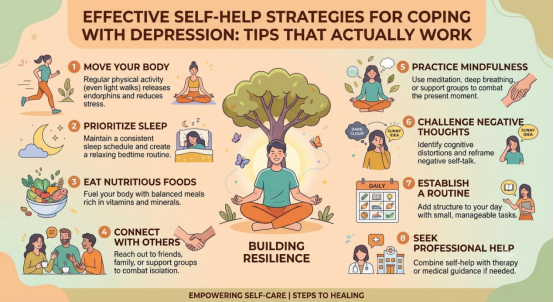
The most proven non-pharmacological self-care strategy for depression is physical activity. Regular aerobic exercise has been shown in numerous meta-analyses to have effects on mild-to-moderate depression that are equivalent to those of antidepressants. This is a remarkable discovery considering how diverse the therapies are.
Exercise improves sleep, lowers inflammation, and stimulates neurogenesis in the hippocampus, an area that shrinks in depression. Additionally, it offers the behavioral stimulation that ends the cycle of despair and inactivity.
3. Practical advice
The most evidence supports 30 minutes of moderate-intensity activity most days of the week, such as brisk walking, cycling, or swimming. When you’re depressed, your drive to work out is usually at its lowest, which makes it harder than it sounds. Useful framings include starting with 10 minutes, doing it at the same time every day, and approaching it as medication rather than a choice.
4. Activation of Behavior
Behavioral activation is a self-care concept as well as a stand-alone therapy: consciously doing things that make you feel good about yourself, especially when you’re not feeling motivated. Depression causes a reversal of motivation-action: whereas healthy individuals usually experience motivation before acting, depression suppresses motivation, making it necessary to wait forever to feel ready.
This is reversed by behavioral activation: mood and motivation usually follow the action, even if it seems futile. This is not about trying to be happy. It is about being connected to the pursuits and connections that offer pleasure and significance, even when those things seem far away.
5. Avoid Consuming Too Much Alcohol

Alcohol might cause problems for certain individuals. You might overindulge in alcohol to pass the time or to deal with or conceal your feelings. However, drinking won’t make your worries go away and may perhaps make you feel worse. Make an effort to consume a balanced diet.
Some people are in danger of being underweight because they don’t feel like eating when they’re depressed. Others may gain weight because they find solace in food. Your appetite may also be impacted by antidepressants. See your doctor if you’re worried about losing weight, gaining weight, or how antidepressants are impacting your appetite.
6. Establish a Routine
People who are depressed may develop irregular sleep patterns, sleeping during the day and staying up late. There is a simple self-help tip for depression. Make an effort to wake up at your regular time and follow your schedule as closely as you can. Your eating habits may be impacted by a lack of routine. Make an effort to continue preparing and consuming regular meals.
7. Regularity of Sleep
Through circadian mechanisms, consistent sleep-wake schedules—going to bed and waking up at the same time every day, including weekends—have particular antidepressant effects. Restoring circadian regularity is one of the most neglected self-care strategies since depression and circadian disruption are intimately related.
By enhancing the circadian rhythm’s morning phase, morning bright light exposure, such as utilizing a light therapy lamp or going outside within an hour of waking, amplifies this effect.
8. Social Interaction
Depression causes social discomfort and disengagement, making it challenging to maintain social ties. Additionally, it is one of the most crucial self-care practices since social connection regularly protects against depression, whereas social isolation continuously exacerbates it.
Forcing uncomfortable social connection is not the answer. It involves acknowledging that even imperfect social contact is preferable to solitude and maintaining limited, manageable contact, such as a quick text exchange, a quick walk with a buddy, or even being in the actual presence of others without much direct connection.
9. Nature and Sunlight
Light exposure influences mood in a number of ways, including direct impacts on serotonin production, vitamin D synthesis, and circadian entrainment. Spending time outside consistently improves mood, especially in the morning.
Exposure to nature, even for short periods of time, has been shown to have particular effects on stress hormones, mood, and rumination. In controlled research, green locations are more effective at reducing rumination than urban settings. It will lessen the likelihood that you may experience depression.
10. Refrain From Thinking Negatively

Make a list of everything that is good about you and your life (you might need assistance with this), save it in your wallet, pocket, or bag, and read it aloud to yourself each morning or as needed. Remember that you have not always felt this way and that you will not always feel this way, no matter how awful you are feeling.
11. Avoid Biting Off More Than You Can Chew
Make an effort to lower your stress levels. Make your life simpler, even if it means doing fewer tasks or focusing on just one at a time. Set reasonable timelines for doing big activities by breaking them up into smaller, more manageable ones. You are just giving yourself the time and space you require to improve, so don’t condemn yourself for “doing nothing.” Consider it an investment in yourself. You are your top priority and your primary responsibility for the time being.
12. Deep Breathing Is a Simple Self-Help Technique
Stress and anxiety, which react favorably to deep breathing, are frequently linked to low mood. Just controlling your breathing is what deep breathing entails:
Inhale through your nose, then hold the breath for a few seconds. Next, press your lips together and slowly release the air. Breathe out as far as is comfortable. Continue this cycle until you feel significantly more at ease. Try it right now to see if it makes a difference.
13. Accept Yourself as You Are
Millions of individuals, including some in your life, suffer from depression. You might not be aware that they deal with comparable difficulties, feelings, and barriers.
You may be able to deal with depression if you are loving, accepting, and open to yourself and what you’re going through.
14. Recognize That the Present Does Not Portend the Future
Internal feelings and ideas are subject to daily fluctuations. You can assist yourself in remembering this by maintaining a mood diary or journaling about your experiences.
Remember that you still have tomorrow to try again if you didn’t succeed in getting out of bed or achieving your goals today. Allow yourself to acknowledge that although there will be challenging days, there will also be easier ones. Try to anticipate the new beginning tomorrow.
15. Evaluate the Components: A Self-Help Approach to Depression
Recollections with challenging feelings can be tinged by depression. You can discover that you are concentrating on things that are unproductive or seem challenging. Try to refrain from making such broad generalizations. Make an effort to see the positive. If it’s helpful, list the significant aspects of the day or event. You can keep track of your accomplishments and fun activities during the day.
Seeing how much weight you’re placing on one item could help you focus on the useful parts rather than the overall.
16. Speak With a Therapist
The first thing to do if depression is too much for you to handle is to get in touch with your therapist. Talk honestly about your feelings, ideas, and life experiences with a mental health expert. This can be very beneficial to you since it makes it simpler for you to comprehend your symptoms and triggers and create a successful treatment plan that includes therapies, drugs, and typical coping mechanisms for depression.
To choose the best course of action for your mood problem, collaborate with your therapist. This entails heeding their advice by routinely attending therapy sessions, taking prescription drugs as directed, and keeping up with follow-up appointments.
17. Change Your Perspective
Millions of individuals worldwide suffer from Major Depressive Disorder (MDD), a prevalent mental illness. Even though every person’s experience is different, many people deal with comparable everyday difficulties and emotional difficulties.
It’s critical to accept your illness with compassion and honesty rather than giving in to the burden of despair. Acknowledging that you have a mental illness is a crucial first step toward recovery, not a sign of weakness. It is possible to recover, but it takes dedication, perseverance, and the proper assistance.
18. Refraining from Using Drugs
Alcohol and drug usage can exacerbate depression. In actuality, major depressive illness and drug use disorder 10 can coexist. While narcotics, alcohol, and nicotine may provide some short-term respite when dealing with depression, they can also worsen the symptoms over time and raise the risk of suicide.
Conclusion
A variety of self-care techniques can help control symptoms and enhance general well-being when dealing with depression. Certain self-care techniques work, but others might not yield the expected results. It’s critical to distinguish between self-care practices that actually benefit people and those that don’t. Exercise, for example, has been shown to alleviate depressed symptoms through established processes, making it the most effective non-pharmacological self-care intervention for depression. Furthermore, behavioral activation is a self-care concept that promotes people to partake in activities that make them feel good about themselves, even in the absence of motivation. When incorporated into everyday life, these techniques can bolster the treatment plan and aid in recovery.
Frequently Asked Questions
1. Can self-help really improve depression?
Indeed. Mild to moderate depression symptoms can be lessened by adopting healthy habits, but severe cases may require expert therapy.
2. What are the best daily self-help tips to cope with depression?
Exercise, eat well, sleep enough, stay connected with loved ones, and practice mindfulness.
3. How long do self-help tips take to work?
With consistent effort, many people see improvements in a matter of weeks.
4. When should I seek professional help for depression?
If symptoms last over two weeks, worsen, or affect daily life, consult a mental health professional.
5. What should I avoid when coping with depression?
Avoid isolation, alcohol or drugs, poor sleep, and ignoring your symptoms.